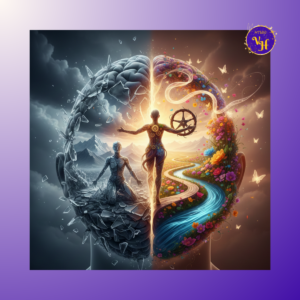
When Images Update the Brain:
From Being at the Mercy of Circumstances to Personal Agency
Or from a Frozen Snapshot of Memory to Lived Efficacy
Why Inner Images Hold More Power Than You Realize
There are memories that cannot simply be put into words. They run deeper, appear in fleeting scenes, surface when you least expect them, and shape your actions more than you care to admit. This is precisely where an aha moment occurs, capable of changing everything. Your brain does not first store experiences in sentences, but in images, precise, embodied, and rich in detail. And because these images are malleable, they carry the key to genuine transformation. Anyone who has witnessed an image shift, fear turning into clarity, chaos into order, stagnation into actionable power, understands that shaping experience moves far more than words alone ever could.
How Images Reveal Solutions and Empower You to Act
An image shows your story and it can transform it. The moment you see it before you, it becomes clear that it is more than a memory. It is a key that opens doors often closed to words alone. Inner images are the way your body stores and recalls experiences, and they are closely linked to your thoughts. While thoughts shape language and concepts, images provide the sensory foundation on which they rest. Both are intertwined: thoughts evoke images, images shape thoughts. You surely know images that stick in your mind, that keep resurfacing and causing mischief, scenes that return on their own even though they should be long past. Within this lies the opportunity: by working with these images, you change not only your thinking but also how your entire organism responds.
They are directly connected to your breathing, muscle tension, and heartbeat, drawing you in without your ability to resist. Words rarely reach this level, yet images speak directly to the networks where experience, memory, and emotion converge. Where language and thought reach their limits, the leverage arises to reclaim calm and the freedom to act.
What Inner Images Are and Why They Matter
Inner images are stored sensory fragments, snapshots of what you have experienced through your eyes, ears, or body, and they are particularly strongly encoded under stress. They are often fragmentary: a perspective, a smell, a sound, a fleeting moment. Especially under stress, these fragments imprint deeply. These fragments often govern your feelings and bodily reactions without you being able to consciously name them.
Inner images are embodied. What you remember is not just a thought; it is a sensory trace, linked to pulse, muscle tone, and breathing. When the image surfaces, your autonomic system responds: heart rate rises, muscles tense, the body “prepares.” Words alone rarely suffice to change this trace. Images, however, act directly. That means when you work with them, you can calm your bodily alarm reaction at its root.
Our imagination of the future comes from the same source as our memories. What we perceive as “new” is, in truth, a new combination of past experiences. Inner images form the basis of your predictive processes: from memories emerge expectations, and recurring images reinforce these learning traces. When certain images appear repeatedly, they solidify patterns. Even the smallest triggers can elicit the same reactions. This is helpful in stable situations, but risky when old images trigger alarm in new contexts. Here lies freedom: by changing the images, you also change your expectations, your reactions, and thus your future actions.
The challenge is that inner images are often fragmentary. Under stress, the organizing cortex functions in a limited way. Snapshots remain that feel disconnected. A single detail can activate the old pattern, even when no real danger exists. This is how loops of anxiety or repetition arise. Working with images breaks this endless cycle: by organizing and connecting images, you assemble the puzzle into something coherent and complete. The brain recognizes that the event is over and can settle.
Inner images are malleable, and that is the opportunity. Each time you recall them, the trace becomes unstable. This “reconsolidation” opens a window: during this phase, the image can be altered and re-anchored. A newly placed detail, a deliberately shifted perspective, a different color, and the stored reaction loses its overwhelming force. In this process, you overwrite the old without erasing it; it remains part of your story, but no longer controls you. For you, this means you can reshape your story in direct experience.
Inner images are the interface of emotion, thought, and action. They link what you feel physically with what you expect and how you act. By working with images, you directly regulate the interaction between body and meaning and regain agency. This opens space for decisions that were previously blocked. Inner images also structure relationships. Who stands where, who turns away, who looks at you? These scenes make proximity, distance, recognition, and boundaries visible. They give you the opportunity to reposition yourself.
From Chaos to Clarity: When the Image Shifts and Change Becomes Visible, Tangible, and Effective
Sometimes the inner world feels like a film without an ending. The same scenes play over and over, you know every angle, yet the ending is missing. This is exactly where images come into play.
Sequential Order: Closure Instead of Repetition
Many problems persist because inner images remain fragmented, loose snippets without beginning or end. Your brain does not register “It is over.” However, when you make the sequence visible image by image, a coherent narrative emerges. Suddenly the drama transforms into a story that is allowed to conclude. The brain notes “That was then, but now it is over.” This brings more than calm. It is like an internal reordering. Rumination loses its power, repetitive patterns dissolve, and the energy previously locked in constant alertness is freed for something new.
Surprise Interventions: True Novelty Instead of Just New Combinations
Thinking knows only variations of the familiar. Many problem-solving attempts go in circles for this reason. Creative shaping breaks through this boundary. An illogical stroke, an unexpected splash of color, a metaphor that appears out of nowhere—these bring sparks that were not planned. Such surprises open doors the conscious mind cannot find. Suddenly, solutions emerge that previously seemed impossible. These “wow moments” work wonders. Your system realizes that there are more possibilities than your mind has allowed so far.
Cognitions: Recognizing and Overwriting Mental Traps
Not only images but also thoughts can be prisons. Old beliefs like “I must not fail” or “I have to be strong” act like invisible chains. They often go unnoticed in everyday life, yet in the creative process they appear in the images, black on white. The difference is that you can see them. And once you see them, you can change them. A single stroke, a correction, a new detail, and the old rule loses its power. From this arises a quiet, powerful aha moment: you are not wrong, but the rule that held you captive was. This experience liberates and is far more effective than mere rethinking because it is anchored in both image and body.
In Short: What Emerges
When images are consciously brought forward, meaningfully ordered, newly connected, and physically embodied, the entire system changes. The inner alarm quiets. Processes that once overwhelmed you become understandable. Relationships clarify, surprising solutions appear, and you feel agency returning. This is lived neurobiology. Change is visible, tangible, verifiable, and it lasts.
What Happens in the Brain: Why Creative Work Changes More Than Words
Imagine your brain as a vast archive, endless rows of shelves filled with memory folders. Some are neatly labeled and complete, you can open them, read through, and close them again. Others lie open, tattered, spilling over repeatedly. Stressful experiences behave in exactly this way. They slip into the “hot” memory zones responsible for alarm and remain disorganized. That is why they pop back into consciousness so abruptly.
The Reconsolidation Window
When you actively shape an inner image, something crucial happens. The memory is recalled, and at that precise moment, a biological window opens. Neuroscience calls this reconsolidation. Memories are not rigid snapshots but dynamic traces. Each time you recall a memory, it becomes temporarily unstable. During this instability, neural connections are malleable before being stored again. Here lies the leverage: working with the image in this window allows the modified version to take hold. The old pattern is overwritten without being erased, a neurological update process.
Two Networks Working Together
Normally, the brain runs two systems separately:
- The fast alarm pathway through the amygdala operates in milliseconds. It detects shapes, colors, movements, and smells. Anything resembling a stored danger signal immediately triggers the alarm cascade: stress hormones like adrenaline and cortisol rise, heart rate accelerates, muscles tense.
- The slow evaluative pathway through the cortex and hippocampus organizes, checks, and compares. The hippocampus recognizes whether a situation is past or present but under stress it works limitedly. Often only a fragment remains: a glance, a sound, a smell. These fragments are enough to trigger the full alarm response.
During creative work, these two systems run in synchrony. The old alarm signal is activated by the amygdala, yet at the same time the prefrontal cortex is engaged. It reevaluates the situation while the calm, rhythmic movement of painting or drawing soothes the autonomic nervous system. Heart rate drops, breathing deepens, muscle tension eases. Your body registers: this is different. It is under control.
Embodied Regulation
Every movement of your hand, every stroke, the rhythm of your lines carries bodily information for your nervous system. Sensory feedback from the eyes, hands, and muscles speaks directly to the autonomic system. That is why you feel the change throughout your body, whereas words alone remain in the head and reach only the cortex.
The Role of Precision
A point that is often overlooked is the brain’s attention to detail when storing memories. Inner images are extremely precise: for example, the direction of a gaze, lighting, color, spatial position, and sometimes even scent or muscle tension. Even a single element can trigger the alarm. By first recreating the scene in a simplified form from the same perspective and then altering it, you deliberately overwrite the stored trace.
Integration and Re-labeling
At the end of this process, something happens that can be explained using the archive metaphor. Your brain reorganizes the open, tattered folder. It is labeled, placed in the correct spot, and closed. The memory is still there, but it has lost its threat. Instead of overwhelming you uncontrollably, it now lies where you can consciously open it or keep it closed.
Your body can relax, your thinking becomes clearer, and situations that once blocked you become manageable again. Change is not only thought but experienced and by being experienced, it endures.
When Images Open Doors
You may already sense as you read that this is not about painting or drawing as art, but about working with the connections between memory, patterns, relationships, emotion, and the body. Every inner image you consciously bring to mind reveals what has held you captive so far and also points the way out. Diffuse chaos becomes a clear sequence, new decisions replace old automatic patterns, and constriction gives way to flexibility.
An image that shifts changes not just your perspective but your entire experience. It is not merely a mirror of your story; it is a tool to transform it. The moment you experience a scene shifting, certainty grows: change is possible. It is visible, tangible, and enduring.
Anyone who has felt this gains the assurance that other blockages can also be transformed. Knowledge alone is not enough; experience makes the difference. It anchors itself in the body, in the breath, in action.
The real question is this: which image do you want to bring to life within yourself right now, and what could open up in your life as a result?
Do you ever wonder why the image in your mind feels more powerful than a simple idea, what this reveals about your sense of self and your trust, and how you can transform it through creative expression?
If You Want More Support…
Sometimes reading and insight alone are not enough. If this is where you find yourself right now, feel free to reach out and connect with me personally.
Schedule your free orientation session now and start turning your dream into reality.