
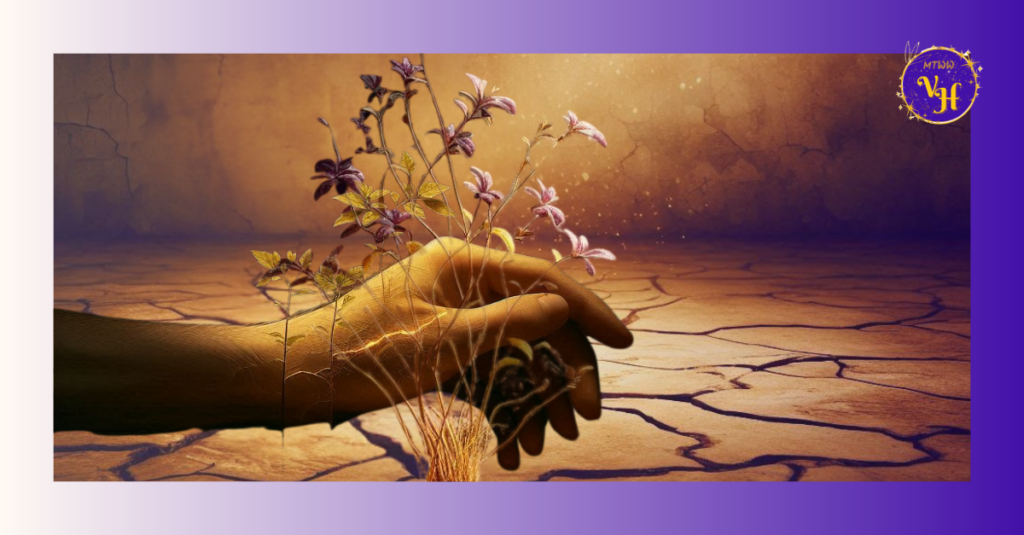
Healing means being whole. And being whole means embracing every part of who I am.
We often carry an idea of healing that does not necessarily make life any easier. As though healing meant that, one day, everything that has hurt us would simply disappear; that memories would no longer cause pain, that our wounds would no longer ache, and that we would somehow become the person we were before.
But what if healing does not mean that everything has to be all right again?
Our experiences remain part of our life story, regardless of how we have learned to live with them. Sometimes, all it takes is a situation in the present moment for a pain to resurface, even one we thought we had long since left behind. That does not mean we have failed to heal.
It means that we are human.
I also know this from my own experience. For as long as I can remember, I tried to get things right, meet other people’s expectations and avoid being a burden. I was an ambitious high-achiever from an early age. And yet, time and again, I experienced how little success could mean: at best, my achievements went unnoticed; I was laughed at, ridiculed and, at worst, even mocked. No matter how well I did, I seemed to remain the runner-up, the one whose achievements and qualities went unnoticed. I felt out of place.
I simply took it for granted that I had to earn my right to exist by being useful to others, and that the only way to achieve this was through performance and achievement. Simply being wasn’t enough. I had to contribute, perform, meet expectations and make myself valuable to deserve my place. Yet what counted as an achievement, what was considered useful or good enough, was never really in my hands. The standards seemed to shift depending on other people, circumstances and situations. Something that had been good enough yesterday could suddenly be dismissed as inadequate today. Even what I had achieved could be stripped of its value in the eyes of others, questioned or denied. Again and again, I experienced how dependent my sense of worth was on external judgements I could neither control nor reliably anticipate. It left me feeling at the mercy of other people’s expectations, constantly having to prove myself against standards that could change at any moment.
For years, I was caught in a difficult in-between space that was hard to put into words. I was good enough for my efforts to be taken for granted. Eventually, even I stopped recognising their value. For years, I had longed to be top of my class because I thought that would finally make people see me as someone who mattered. Yet there always seemed to be someone better, someone who received the recognition I secretly longed for. I kept thinking that if I gave more, if I worked even harder, things might finally change. But they didn’t. Success had become a standard I could never seem to meet. Not because I hadn’t achieved enough, but because I had learned to rely on external judgement and to see my achievements as worthwhile only when other people recognised them. It wears you down. It makes you feel small. My efforts were expected, not acknowledged. Over time, this left me feeling that what I did was worth very little.
Growing up like that made me acutely aware of what often goes unnoticed. I learned to pick up on subtle signals, sense what was left unsaid and anticipate what others might need, often before they were able to express it themselves. Back then, it was a way of navigating everyday life, of adapting, anticipating and finding my way through situations in which I had learned that simply being myself was not always enough.
From the very beginning of primary school, my teachers would ask me to help my classmates with their schoolwork. At fifteen, I was already tutoring and supporting learners, both individually and in groups of up to thirty. I soon realised that difficulties with a subject were often about much more than the subject itself. Each person needed something different to recognise their next step and move forward successfully. I began finding individual solutions, drawing on what I observed and learning from every encounter. Over time, these experiences led me to acquire further knowledge, methods and professional training. They also strengthened my decision to become a teacher, a profession I still love.
Another experience, when I was seventeen, profoundly shaped my understanding of what it means to be genuinely seen and understood. I joined a confirmation weekend as a group leader, expecting to translate from German into English for the participants. Only when I arrived did I realise that I was also solely responsible for the entire group throughout the event. I was completely overwhelmed. By Saturday afternoon, I broke down. It was not just the situation itself that brought me to tears. Everything I had been carrying up to that point came pouring out.
A woman sat with me and listened for two hours. I still remember her dark green Fruit of the Loom sweatshirt. She was the first person who really listened to me, without judging me or trying to offer a solution. For the first time, I felt truly understood.
That evening, I made a decision that changed the direction of my life. I entrusted my life to God and took responsibility for what I believed and how I lived. I committed myself to my prophetic calling and, just as importantly, to being true to myself. I stopped trying to bend myself into the shape others expected of me at all costs and began consciously shaping my own life, guided by my convictions and my faith. I also resolved to give other people the experience of being genuinely seen and heard.
Today, I understand it differently. What once helped me navigate the world has become one of my greatest strengths. I have learned to work with this sensitivity consciously and to bring it into my work.
However, I am fully aware that healing is an ongoing process that will continue for as long as I live. There are things I am still working through, experiences that continue to affect me, and scars that will stay with me for the rest of my life. I no longer expect healing to mean that all of this will simply disappear. My wounds are part of my story, too. Even when they still hurt, they do not make me any less whole. I can honour where I have come from while continuing to shape the life I want to live.
Being whole neither mean being without wounds nor that everything that happened was necessary or that suffering somehow made us better people. We do not necessarily need to find a positive meaning in everything that has hurt us. Some things were simply painful, unfair, deeply damaging, etc. And some have consequences we will have to live with for the rest of our lives.
Everyone has a different story and a different experience of what has hurt them. What one person needs cannot be determined by someone looking in from the outside. There is no universal measure of healing, and no one else can decide when another person should have found their way.
But we can still ask ourselves what is possible now, in the wake of everything that has shaped our history and contributed to our story. That may mean accepting that something will never be quite the same again or allowing ourselves to grieve what we have lost. And sometimes it means recognising that a boundary is necessary, regardless of what may be expected of us.
Acknowledging what has happened is different from supporting its dynamics. Even forgiveness is not an obligation to maintain a relationship or to put up with behaviour that harms us. Understanding where someone else’s actions came from does not mean we owe them a place in our lives.
We can also recognise the fears and beliefs we inherited from our families without having to pass them on to the next generation. We can understand why our parents acted as they did without repeating their behaviour.
I also think we sometimes underestimate how important it is to allow ourselves to change. Some beliefs and ways of behaving may once have protected us or helped us navigate difficult situations. Later in life, those same patterns can stand in the way of living in a way that feels right for us. Letting go of them means recognising that we are allowed to live differently now.
This is closely connected to what sovereignty means to me. It is about regaining the ability to make our own decisions, trust our own perceptions and take responsibility for the life we want to live. It also means recognising that we cannot do everything ourselves. Sometimes we need to act, sometimes we need to allow things to unfold, and sometimes we need to ask for help or accept what others are willing to give.
Perhaps one of the most important parts of healing is learning to live your life as a whole person, with all your experiences, including the marks that they have left. Fully embracing yourself as the wonderful being that you are, with everything that makes you who you are, is a sacred act. You don’t have to wait until the pain is gone. Your experiences are part of you. Some of them will probably continue to affect you throughout your life. They are part of who you are, but they don’t have to dictate how you live your life today.
What does this look like in practice, when we encounter the many different situations life brings our way?