
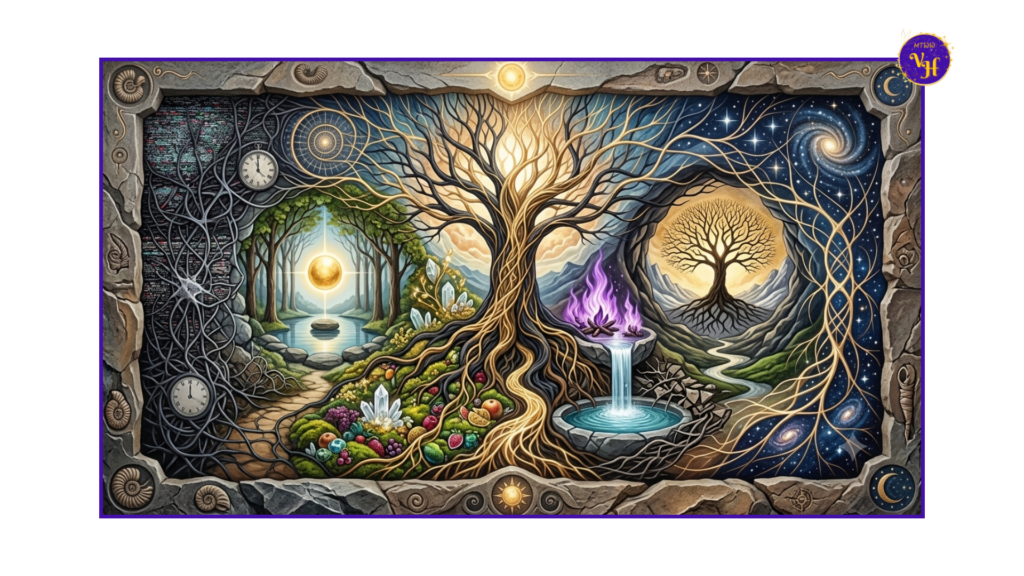
When Time Stops Inside the Body:
The Solstice as a Map of Nervous System Healing and Integration
INTRODUCTION
This article unfolds as a continuous exploration of how natural cycles, particularly the summer solstice, mirror the inner architecture of the nervous system. Each section builds a layered understanding from lived experience to physiological processing.
The Wisdom of the Solstice – Moving from Functioning to Being
Have you ever felt the paradox of checking off every single milestone on your to-do list, yet internally, you never quite arrive?
In a culture that constantly demands forward-projection, our nervous systems are tightly wound in a loop of endless activity. We collect data, process stimuli, and plan the next horizon before the current experience has even had a chance to settle. This continuous acceleration creates a specific kind of exhaustion, which stems from a total loss of internal orientation. For a nervous system shaped by traumatic experiences, this chronic high-alert state is a deep survival strategy that keeps the body trapped in permanent sympathetic tension.
The modern lifestyle functions as a restrictive trap across all areas of our lives, keeping the body in permanent sympathetic tension and cutting us off from our natural rhythms. The summer solstice offers a timeless psychophysiological fixpoint to interrupt this cycle.
The word solstice, or solstitium, translates to „sun standing still,“ marking the precise moment the sun reaches its absolute zenith and halts its movement before changing direction. This astronomical phenomenon lasts for three full days, during which the sun appears to hover at the exact same height in the sky. Symbolically, these three days represent a dedicated cosmic window to let our achievements truly sink in, allowing the intensity of our experiences to echo, settle, and take root within our physical being before any outer movement resumes. Nature structures a deliberate phase of lingering, allowing what has grown to unfold and what has been achieved to stabilise. In trauma processing, this offers a gentle, spacious window for the nervous system to gradually notice that the immediate threat has passed, allowing the body to softly register a true sense of safety right down to the cellular level.
This physical transition carries a far deeper significance that reaches far beyond a simple seasonal marker, serving as a profound template for human transformation. True stability clarifies itself when we grant the nervous system space to return to its natural baseline.
This cosmic cycle offers five profound phases for physical and psychological recalibration:
- The Astronomical Fixpoint: This is a natural, sacred pause to reset the entire system without judgment or the need to justify rest, establishing resting as a legitimate, structural necessity of any developmental process.
- The Celebration of Abundance: We consciously focus on fully realising and honouring the visible and invisible growth of the past six months, allowing the system to shift into a visceral experience of embodied sufficiency.
- Purification: The symbolic power of fire is utilized to release inherited expectations and outdated scripts, allowing us to clear out what no longer serves our path, converting heavy matter into fertile ash for new growth while bonfires fortify the light. Simultaneously, water principles act as tools for clarity, bringing hidden dynamics to light and fully washing away the past to clear the space for an entirely new framework. In trauma work, these rituals provide grounding structure and orientation in the step-by-step discharging patterns that no longer serve our present reality.
- Cosmic Polarity: The central focus here lies on recognizing that maximum light contains the continuous birth of the dark, viewing expansion and introspection as synchronised, complementary forces of a single, functional system. A winter of the soul or a phase of lower energy is the very ground that makes the next expansion fertile, meaning that fatigue or uncertainty receive a valid place in the whole picture.
- Cosmic Alignment: This phase integrates our personal experiences into an unshakeable inner architecture, shifting us from individual isolation and embedding our lives safely within a larger, ordered universe where you realize you are completely sufficient exactly where you stand.
True stability and profound fullness develop when we stop engineering the next strategy, allowing our accumulated experiences to finally arrive in the body. When the mind stops planning the next step, the nervous system calms down, and the body returns to a state of safety and embodied sufficiency.
Where in your life can you accept a natural phase of retreat as a vital preparation for what is to come?
MOVING FROM SYMBOLIC CYCLE INTO PHYSIOLOGICAL REALITY
The following sections translate the symbolic language of the solstice into the biological and neurological processes of the nervous system.
The Physiology of Trauma: Why Knowing is Not Enough
We often believe that understanding our emotional wounds is the key to healing them. We analyse our history, trace our behavioural patterns, and construct a flawless cognitive map of our pain, yet our lived experience remains entirely unchanged when a trigger hits. This persistent disconnect occurs because our most intense distress is not stored as a narrative within the thinking mind, but rather as an active somatic imprint locked directly within our physiological architecture.
Insight provides the cognitive map of our emotional wounds, yet intellectual understanding frequently fails to alter our lived experience because the imprint of overwhelming events resides primarily within our physiological architecture. During overwhelming or highly intense experiences, the conscious mind lacks the capacity to process the sheer volume of distress. This forces the system to fragment and store these unintegrated memories throughout the entire system, where the body remains as a physiological signpost.
To manage the permanent influx of impressions and navigate daily life without being continuously flooded, the system relies on automation operating far below conscious awareness. Under normal circumstances, this subconscious mechanism is highly beneficial, handling repetitive tasks without active deliberation to prevent cognitive overload. However, when faced with overwhelming trauma, this same biological division functions as a vital survival defence. To protect us efficiently and maximize our capacity to survive, the system naturally generalizes from these intense experiences, turning a single event into an automated protective blueprint for the future.
However, because the human nervous system processes reality largely through pattern recognition and similarity, any current event that subtly mirrors the original distressing experience can immediately activate those ancient, isolated survival networks. Highly charged emotional events and repeated experiences form deeply grooved neural pathways, functioning much like an internal highway system where a sudden trigger instantly activates hypervigilant defence mechanisms or protective emotional shielding.
Bridging the gap between cognitive comprehension and actual somatic relief requires moving beyond narrative analysis to actively engage the nervous system. Because the system holds onto these generalized protective responses, this internal blueprint must be directly overwritten by a concrete new experience, functioning as an internal update. This process recalibrates the body’s internal safety cues so it can recognize that the threat of those past situations has passed, as the system has now been successfully updated and overwritten by more current, corrective experiences, thereby ensuring that the traumatic experiences finally remain strictly in the past.
When you look at your own patterns, where do you notice that your mind already fully understands the situation, but your body is still reacting based on an old protective blueprint?
ALIGNING TIME, EXPERIENCE, AND NERVOUS SYSTEM PROCESSING
The next layers explore how the nervous system organizes experience in time, and why integration depends on rhythm, pause, and temporal space.
The Nervous System and the Timing of Experience
The summer solstice reflects a moment within the annual cycle where movement continues within a stable larger order and where experience can settle without losing its place in the overall structure. This temporal structure illustrates how integration depends on timing that is embedded within a broader system of continuity.
The nervous system operates in a comparable way.
Experience unfolds in time, while internal processing follows its own temporal organization that does not always align with external progression. The system continuously receives information, evaluates it, and updates internal models, yet this updating requires conditions in which incoming experience is not immediately replaced by new input.
When experience accumulates faster than it can be integrated, the nervous system continues to organize itself around what has not yet been fully registered. Internal activation remains present because the system maintains continuity with unresolved physiological information.
Integration requires a temporal window in which experience is allowed to remain active without being immediately overridden by subsequent input. This allows physiological information to complete its internal processing and become part of the system’s stable organization.
The nervous system continuously synchronizes lived experience with internal time structures that regulate how information becomes part of memory, prediction, and orientation. When this synchronization is disrupted, experience and internal processing remain temporarily out of alignment, and the system continues to operate from earlier states of organization.
The symbolism of the summer solstice reflects this process.
A temporal pause within a larger cycle allows ongoing movement to remain coherent while internal processes complete their own transformation within the same system of continuity.
The nervous system follows this principle.
Integration becomes possible when experience and internal temporal organization are allowed to align within the same field of processing, so that lived events can fully enter the system without fragmentation across time.
Where in your life do you notice that experience is already present while your internal system is still completing its processing of it?
Astronomical Fixpoint: Why the Nervous System Needs a Pause
The summer solstice marks a unique point within the annual cycle. For several days, the sun appears to remain in the same position before its path gradually changes. Nature includes this pause within its own rhythm.
The nervous system also depends upon periods during which experience can fully register.
Experience unfolds across time. The nervous system continuously receives sensory information, evaluates its significance, and updates its internal model of reality. This process continues beyond the moment an event has ended because physiological integration requires time.
Following prolonged stress or overwhelming experiences, physiological activation can remain present while the nervous system continues processing what has already occurred. The body gradually determines whether an experience belongs to the present or whether it has become part of the past.
This process extends far beyond conscious awareness.
The nervous system continuously updates its internal model of the world through lived experience. Every experience that becomes fully integrated refines this internal model and strengthens the body’s capacity to recognize its current environment with greater accuracy.
The symbolism of the summer solstice reflects this biological process remarkably well.
A fixed point creates the conditions for orientation. The pause within the annual cycle allows transition to become part of the whole movement rather than remaining an unfinished process.
The nervous system follows a remarkably similar principle.
Time allows experience to become physiology. As experience settles into the body, the nervous system gradually registers that a lived event has become part of its internal history.
Where in your life have you already moved forward while your nervous system is still registering what has already happened?
Celebration of Abundance: How the Nervous System Registers Completion
Many traditions associated with the summer solstice include rituals of celebration. These rituals acknowledge what has already grown, what has already been gathered, and what has already become part of life.
The human nervous system also depends upon experiences of completion.
Every experience leaves physiological information behind. The nervous system continuously evaluates whether an experience remains active within the present or whether it has become part of the body’s accumulated history.
Completion is a physiological process.
The nervous system gradually registers that an experience has reached its natural conclusion. This registration allows the experience to become integrated into the body’s internal model of reality, where it contributes to future perception without requiring ongoing physiological activation.
Following prolonged stress or overwhelming experiences, this process may remain incomplete. The nervous system continues allocating physiological resources to experiences that have not yet been fully registered as completed. This ongoing allocation influences attention, expectation, and perception because the body continues organizing itself around information that still carries unresolved significance.
The symbolism of the summer solstice reflects this process with remarkable precision.
Celebration acknowledges what has already become real. The nervous system also benefits from recognizing what has already been lived, because recognition allows experience to settle into the body’s accumulated history.
Completion expands the internal record of lived experience. Every completed experience contributes additional information that strengthens the nervous system’s capacity to orient itself within the present.
Where in your life has something already been completed, while your nervous system is still carrying it as an ongoing experience?
Celebrating the Abundance That Already Exists
Abundance is something that becomes visible when we learn to recognise what is already unfolding, rather than continuing to pursue more. Just as the nervous system registers completion within experience, it also becomes more coherent when completion is witnessed in relationship, what we cannot fully see in ourselves is often already visible through others.
The nervous system naturally gives priority to what is unfinished, uncertain, or demanding. Experiences that have become stable, meaningful, or woven into everyday life gradually require less attention and can therefore become less consciously perceived.
Friends contribute valuable information to this process. They often notice changes that have become so familiar to us that we no longer recognise them ourselves. Small moments of increased ease, greater flexibility, or quiet acts of courage can already represent significant change, particularly when viewed in the context of where someone started.
One way of making abundance more visible is to slow down the moment of perception and describe what is actually observable, without interpretation or evaluation. Recognition becomes clearer when it is anchored in concrete behaviour, not in general impressions.
𝐐𝐮𝐞𝐬𝐭𝐢𝐨𝐧𝐬 𝐬𝐮𝐜𝐡 𝐚𝐬 𝐭𝐡𝐞𝐬𝐞 𝐜𝐚𝐧 𝐡𝐞𝐥𝐩 𝐛𝐫𝐢𝐧𝐠 𝐭𝐡𝐢𝐬 𝐢𝐧𝐭𝐨 𝐚𝐰𝐚𝐫𝐞𝐧𝐞𝐬𝐬:
- Where have you noticed me pause instead of reacting automatically?
- What feels easier for me today than it did a few weeks or months ago?
- When have you seen me respond differently to a situation that would once have overwhelmed me?
- What small change have you noticed in me that I may never have recognised myself?
Speaking these observations aloud allows them to become part of conscious awareness. The act of naming specific moments gives the nervous system clearer reference points for integration, because experience becomes anchored in concrete episodes rather than diffuse impressions.
After something has been named, the nervous system needs a brief pause to register it as part of lived experience. Celebration happens after recognition by deliberately marking what has been noticed.
This can be as simple as, e.g.
- saying it out loud and allowing a moment of silence,
- taking a walk together while reflecting on what has just been recognised,
- writing the observations down and reading them back to each other without commentary,
- sharing a meal or a cup of coffee while staying with the conversation instead of immediately moving on,
- choosing one small ritual that marks the moment, such as lighting a candle, making a toast, or taking a photograph together to remember what has been celebrated.
The key element is that what has been seen is briefly held so it can register, allowing the experience to become more fully encoded, before is moved past. Integration continues when the recognition is made visible beyond the moment. One way to support this is by collecting what has been noticed.
To try this, choose one person today and share three specific moments of change you have noticed in each other. Then take one small moment to acknowledge it together before moving on.
The Practice of Making Abundance Visible
Building on the idea that abundance becomes more visible through shared recognition, the next step is allowing what has been noticed to stay.
What is recognised in a moment often disappears again if it has no place to remain. The nervous system tends to prioritise what requires attention in the present. What is already working, what has already shifted, and what has already changed can therefore remain under-registered unless there is a way to return to it.
Celebration happens when recognition is given time to settle. After something has been named, the nervous system needs a brief pause to register it as part of lived experience. Without that pause, even accurate recognition can pass too quickly to be integrated. Remaining with the moment for a little longer gives the nervous system additional time to organise the experience, allowing recognition to settle into the body’s accumulated history.
One way to support this is by collecting what has been noticed. Recording these moments gives recognition a place to remain available beyond the interaction in which it first emerged. Recording these moments creates a place where recognition can remain accessible beyond the interaction in which it first emerged.
A Recognition Board can be a shared or individual space where these observations are gathered over time. Each entry captures one concrete moment in the words in which it was first spoken, allowing the original observation to remain intact whenever it is revisited.
Possible formats include:
- a shared notebook where friends write down one observed change after each meeting
- a simple phone note titled What is Working that is added to after each conversation
- a physical board where small post-its capture specific moments of change
- voice notes collected after meetings and replayed later
- a weekly message exchange where each person sends one observed win from the other
a visual timeline where small shifts are placed in chronological order to show movement over time
Revisiting these observations keeps them available to awareness across time. Reading them aloud, listening to them again, or simply seeing them collected in one place provides repeated opportunities for experiences that have already occurred to become more firmly established within the nervous system.
The purpose is repeated exposure to experiences that have already become real. Each return strengthens the nervous system’s familiarity with what has already changed, making these experiences increasingly available as reference points in the present.
Write down only what was observed, allowing the moment to remain exactly as it was recognised.
Return to it later and notice what feels different when the experience has had time to settle.
Purification: How the Nervous System Updates Its Internal Predictions
Many cultural traditions connected to the summer solstice include acts of cleansing. Fire and water are often used as symbols for releasing what no longer belongs to the present moment and making space for what is emerging.
The nervous system also operates through continuous processes of updating.
Every experience contributes to internal predictions about what is likely to happen next. These predictions shape perception, attention, and physiological readiness before conscious thought becomes involved.
When experiences remain unprocessed, the nervous system continues to rely on predictions formed under different conditions. These predictions were once adaptive and supportive of survival. They continue to operate until new information becomes available through lived experience that allows the system to revise its internal model.
Update happens through integration.
As experiences are fully registered and completed, the nervous system gains access to additional information that modifies its predictive patterns. The body gradually reduces reliance on older anticipatory responses and begins to respond more accurately to present conditions.
The symbolism of purification reflects this process.
What has been lived becomes available for reorganization. The nervous system incorporates new information into its predictive structure, allowing previous patterns to lose their automatic dominance and become part of a wider internal context.
This process does not remove experience. It reorganizes how experience informs the present moment.
Where in your life is your nervous system still predicting the present based on conditions that have already changed?
Cosmic Polarity: The Reorganization of Physiological Memory
The summer solstice marks a point in the annual cycle where maximum light is reached and the cycle continues without interruption. This moment reflects a principle of continuous movement within a stable larger order.
The nervous system organizes lived experience through a similar process of ongoing reconfiguration.
Every experience contributes to physiological memory, shaping how the body anticipates, responds, and orients itself within new situations. These memories are not stored as static records. They remain active within the body’s predictive architecture and influence perception in real time.
As experience accumulates, the nervous system continuously adjusts the relative influence of different memories. Some experiences remain highly active because they carry strong physiological significance. Other experiences gradually lose dominance as new embodied information becomes available and the internal model expands.
Reorganization happens through this continuous redistribution of influence.
The nervous system operates through the dynamic interaction of multiple layers of physiological memory, each contributing to the continuous organization of perception and response within an evolving system.
The symbolism of cosmic polarity reflects this principle of continuous interplay within a single system.
The internal landscape is shaped through ongoing adjustment of relational patterns between experiences. This allows the nervous system to maintain flexibility while preserving continuity within its overall structure.
Where in your life do you notice older physiological patterns still carrying more influence than your current lived experience?
Integration as Embodied Time Collapse
The summer solstice reflects a moment within the annual cycle where maximum continuity is present while movement remains uninterrupted. This phase describes a point in which temporal progression becomes less segmented within a larger ongoing structure.
The nervous system operates in a comparable way.
Experience is organized as continuously active layered physiological processes extending across lived time. It remains active within ongoing bodily regulation as overlapping physiological layers contributing to perception, orientation, and response. These layers continue to influence perception, orientation, and response beyond the moment in which an event originally occurred.
Integration describes a process in which these layered experiences reorganize into a continuous field of physiological activity and become part of a continuous internal organization.
In this process, the nervous system organizes regulation through a unified field in which multiple temporal layers contribute simultaneously to current orientation.
Prediction, perception, and memory operate within a shared regulatory field of ongoing physiological updating. This allows the system to respond from accumulated experience without needing to isolate individual time points as separate reference structures.
The symbolism of the solstice reflects this principle. The sun standing still describes a phase in which movement is still present but no longer perceived as segmented progression.
The nervous system follows this same organizational logic. Experience becomes integrated when temporal separation within physiological processing decreases and lived history becomes part of the same ongoing field as present input.
Where do you notice that your present experience is already shaped by multiple layers of lived time operating at once?
Cosmic Alignment: How Internal Orientation Becomes Coherent
The summer solstice reflects a moment within the annual cycle where a stable reference point emerges while the system remains in continuous movement. Orientation arises within the same ongoing process of change and does not exist outside of it.
The nervous system operates in a comparable way.
Internal orientation emerges through the organization of multiple active systems within a shared field of reference, where different physiological states contribute simultaneously to orientation.
Physiological memory continues to carry different levels of activation within the system. Prediction continuously emerges from this accumulated structure and organizes perception before conscious awareness becomes involved.
At the same time, sensory input continuously updates the system and modifies how these internal structures relate to present conditions.
Alignment emerges when these processes are integrated within a continuously updating orienting field.
This orienting field emerges through the integration of all active physiological states into a continuously updating system of reference, in which memory and ongoing activity are included within the same process of organization.
Within this field, prediction, memory, and perception are organized through a shared structure that continuously updates itself through experience.
The symbolism of cosmic alignment reflects this process.
A reference point functions as a capacity of the system to maintain coherence across changing internal and external conditions through continuous reorganization of its active processes.
The nervous system follows this principle.
Internal orientation becomes coherent when all active physiological processes contribute to a single integrated field of reference that remains continuously updated through lived experience.
Where do you notice moments in which your internal orientation feels organized beyond individual reactions or memories?
The Nervous System as a Predictive Solstice Model
The summer solstice reflects a moment within the annual cycle where the system reaches maximal continuity within ongoing movement. This point is fully embedded within the cycle as a structural reference that remains stable across continuous change.
The nervous system operates in a comparable way.
Across all previous phases, experience is a physiological process that is stored, registered, reorganized, and integrated within a continuously updating system. Each phase contributes to a progressive refinement of how the body organizes prediction, perception, and orientation within lived reality.
The nervous system functions as a predictive system that continuously constructs internal models based on accumulated physiological experience. These models are continuously adaptive regulatory structures shaped by ongoing sensory input and accumulated lived history. They function as ongoing organizing patterns that continuously integrate sensory input and physiological history into a unified predictive field.
Across this process, stability emerges through continuous coherence within ongoing change. Stability emerges through the ongoing organization of a predictive field that remains coherent while continuously updating itself through experience.
The solstice serves as a structural metaphor for this organization. A reference point within continuous movement allows orientation to remain possible as conditions shift. In the same way, the nervous system maintains coherence through internal reference structures that are continuously refined through lived experience.
Across the full cycle of trauma, pause, completion, purification, polarity, and integration, the system shifts into increasingly unified patterns of physiological organization within a continuously updating predictive field. This field is not a fixed endpoint, but a continuously adaptive structure in which experience becomes increasingly organized within a coherent internal model.
In this sense, the nervous system moves toward increasing coherence within ongoing change.
The predictive model becomes more refined through expanded capacity to organize complexity, and through continuous enhancement of its ability to maintain coherence across complexity.
The solstice model therefore describes a living principle of regulation: a system that remains fully embedded in time while continuously reorganizing how time is internally represented and used for orientation.
Where in your experience do you notice a stable internal reference that continues to hold even as everything else is changing?